Feature
Atmospheric pressure measurement
A digital barometric sensor is integrated on each onboard computer. Sensor range and accuracy cover expected flight and impact conditions.
ZCT3 CanSat 2026
The project focuses on collecting, processing, and transmitting environmental and ionizing-radiation data through a distributed node network, without requiring direct human intervention.
Core
Remote observation of environmental conditions and system state.
Core
Live telemetry plus persistent records for deeper analysis.
Core
Redundant nodes maintain operation during partial failures.
Project overview
The team designs hardware, firmware, and data flow as one system. Every decision is validated against real flight, landing, and recovery conditions.
Area
Navigation, telemetry, and robust onboard software behavior for mission-critical stages.
Area
Compact board design focused on signal integrity, reliability, and serviceability.
Area
Joint work across team roles and external institutions involved in payload and testing.
Area
Engineering under hard constraints with repeatable validation and system-level thinking.
Our mission
Our core mission is to deliver a modular, redundant sensing platform for operation in high-risk environments. The architecture is designed for scalability, fault tolerance, and clear operational interpretation.
The system satisfies the mission only when all conditions below are met in parallel.
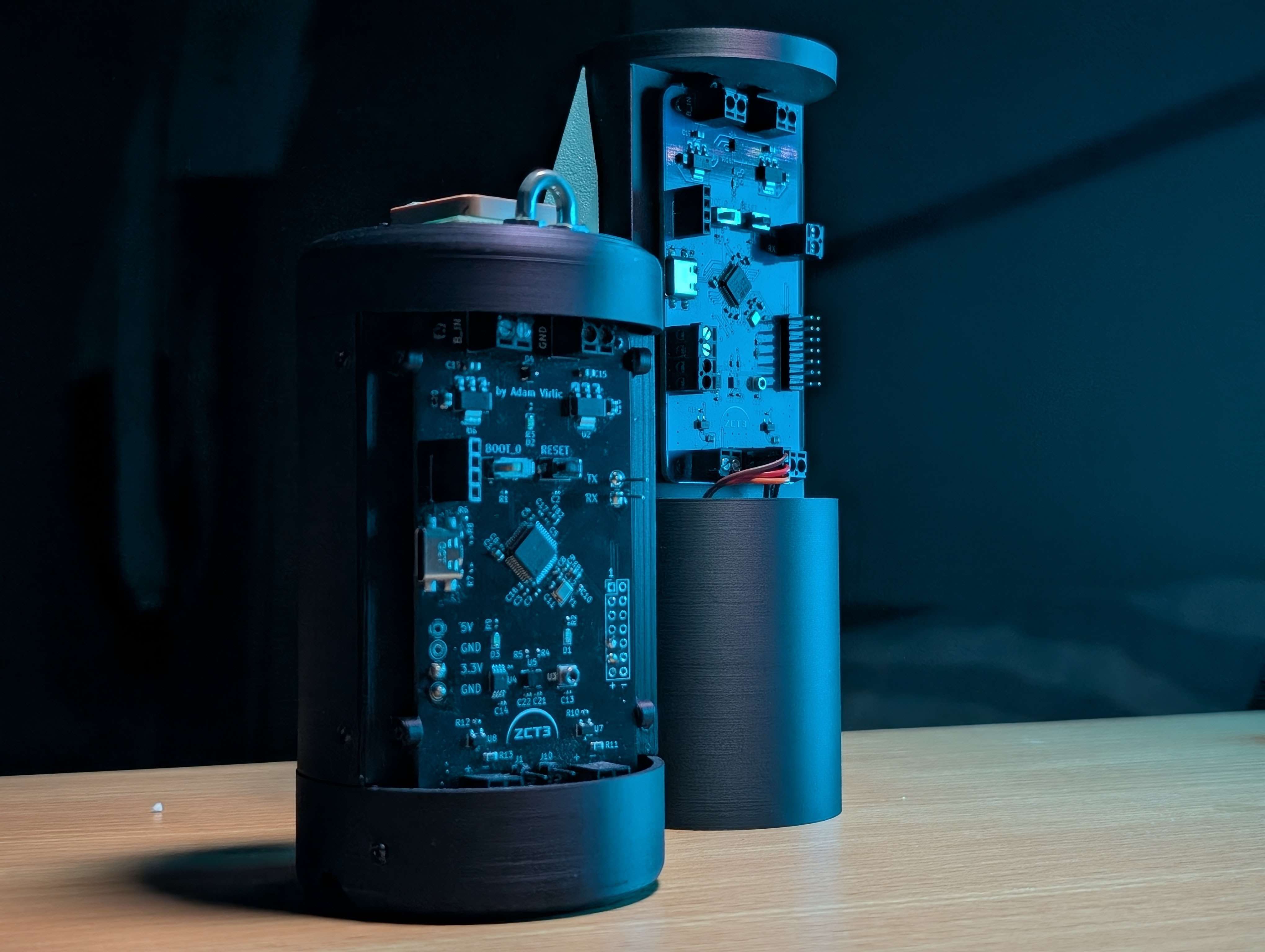
The redundant design means each of the two onboard computers performs measurements independently.
A digital barometric sensor is integrated on each onboard computer. Sensor range and accuracy cover expected flight and impact conditions.
A combined temperature-humidity sensor is positioned to minimize airflow effects and heating from onboard electronics.
An IMU unit (accelerometer + gyroscope) provides acceleration and rotation data with a range suitable for descent and landing dynamics.
Each compute node includes a GNSS module with its own antenna for trajectory tracking and post-landing localization.
Data is collected locally and transmitted wirelessly to the gateway. The architecture supports transfer even without direct line of sight.
An external ionizing-radiation sensor, developed in collaboration with FEI STU Bratislava, is integrated as an independent module.
Architecture
Core subsystems are structured to support long-term extensibility without breaking the primary telemetry path.
Each node has its own sensors and autonomous capability. If one node fails, the other continues operation.
Temperature, humidity, pressure, IMU, and GNSS are present on each computer to provide measurement redundancy.
The interface is prepared for a radiation sensor and additional modules without major system changes.
2S battery pack (2x 18650 Li-ion), USB Power Delivery, and solar input with MPPT regulation.
Gallery
Select any thumbnail to display it in the large preview panel.
Contact
Email is the fastest path for technical questions, partnerships, or project support.